Take 5: How Care Management supports Blue Cross members with Emily Griese
"Take 5" is a series in which we pose five questions to a Blue Cross and Blue Shield of Minnesota leader and learn more about who they are, what they do, and how they help our members live their healthiest lives.
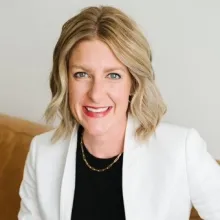
This edition of “Take 5” features Emily Griese, Vice President of Clinical Operations.
Can you tell us about your career and what drew you to this line of work?
I have a Ph.D. in psychology, so I’ve always been fascinated by why people think, feel, and behave the way they do.
I spent the early part of my career in public health, working with rural and tribal communities in the Midwest. I was welcomed into people's homes during some of their most vulnerable moments. I learned that health is more than just about access to doctors and hospitals. It's about the environments, barriers, and social supports that surround people every day.
I then transitioned from public health into healthcare administration, spending several years working on value-based care strategies. That work reshaped my thinking about how we pay for healthcare. Can we focus on outcomes instead of the number of visits? How do we align incentives so that the system truly supports better health?
I also spent time on the provider side of healthcare. I was fortunate to work in a care delivery system that also had a health plan, which led to leadership roles in operations and as chief operating officer. Those experiences broadened my understanding of all the levers a health plan can pull to support better health outcomes.
What do you want people to know about your current role as Vice President of Clinical Operations at Blue Cross?
I’m thrilled to be focusing on care management and utilization management again because I know it can make a positive difference in health outcomes and healthcare costs.
At Blue Cross, I have the privilege of leading more than 300 utilization management, vendor management and case management professionals. Our utilization management team ensures members receive care that aligns with the highest standards of safety and clinical efficacy. They work closely with providers to make those decisions as collaborative and seamless as possible.
Our case managers are really the coordinators or "quarterbacks" of our members' healthcare. They see the full picture of a member's healthcare across multiple systems. They also know the member's plan benefits, how they're using them, and where there are gaps in care coordination. That insight allows them to solve problems in ways no one else in the care continuum is equipped to do.
Many case managers are Registered Nurses. What do you think motivates them in this role?
I commonly hear two reasons why our Blue Cross nurses love their roles as case managers:
- They love solving complex problems.
They hold all the pieces-claims, utilization, social needs, clinical history-and get to assemble them into a plan that genuinely helps someone. They have the unique ability to help members move from point A to point B in a way that is seamless, effective, and rooted in compassion.
- They meet members at their most vulnerable moments.
When someone comes home after leaving the hospital, they often aren't sure what to do next. Our case managers are often the first reassuring voice they hear.
A lasting memory for me is about a member whose daughter was struggling with mental health crises and cycling in and out of the emergency room. Our case manager worked tirelessly to find the right inpatient treatment. While supporting the daughter, she also supported the mom, who didn't even realize how deeply she needed a partner in the process. That story sticks with me. It shows the depth of human connection involved in this work.
What are your goals for Care Management?
I think a high‑functioning care management program does two things exceptionally well:
Transitions of care—supporting members when they leave the hospital and most need guidance.
- Predicting what comes next—using data and trends to intervene before a crisis happens.
This type of proactive, AI-driven model is work I've helped build in the past, and I'm excited to expand it here. It's where we can have a tremendous impact as a health plan.
What do you see for the future of Care Management?
Our team has grown from 15 to 20 nurses years ago to hundreds of dedicated professionals today. That's because this has proven to be such a critical area for our industry.
In the future, I see more use of new technologies to help us reduce our administrative burden and allow us to focus on predictive, proactive care.
I want everyone on our team to be able to work at the top of their training and focus on what truly matters: the meaningful, vulnerable, life-changing work they're trained to do. That's the work that motivates me. And I'm incredibly proud to do it at Blue Cross.